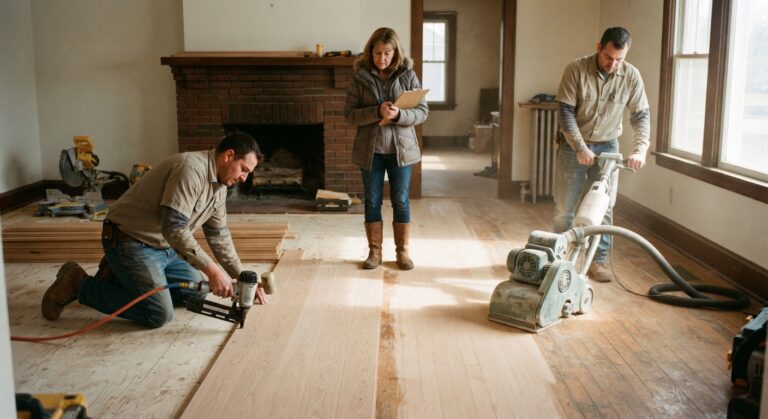

Northeast Ohio’s climate ranges from humid summers to freezing winters, creating significant seasonal wood movement. The best hardwood flooring for this climate is engineered hardwood with a thick wear layer, or species like white oak and hickory that handle humidity swings well. TH Custom Hardwood helps Northeast Ohio homeowners select species and formats proven to perform across all four seasons.
Why Northeast Ohio’s Climate Makes Flooring Selection Critical
Northeast Ohio experiences some of the widest humidity swings of any region in the eastern United States. Summers routinely push indoor relative humidity past 70 percent without a dehumidifier, while forced-air heating in winter can drop indoor humidity below 30 percent. That 40-point seasonal swing puts significant stress on any wood product.
Hardwood flooring expands when it absorbs moisture and contracts when it loses moisture. In a climate like Cleveland, Akron, or Canton, boards that are not well matched to these conditions can cup, gap, or squeak within a few seasons. Choosing the right species and format from the start is the most important decision a Northeast Ohio homeowner can make.
The good news is that hardwood flooring selected with this climate in mind, installed by a team experienced with Ohio conditions, and maintained properly will last for decades. TH Custom Hardwood has installed and refinished floors across Northeast Ohio since 2006 and understands exactly which products hold up here.
The Role of Wood Species in Climate Performance
Not all wood species respond to humidity changes the same way. A species with a low tangential shrinkage coefficient moves less per percentage point of moisture change, making it more stable in climates with wide seasonal humidity swings.
White Oak is the top-performing species for Northeast Ohio conditions. Its Janka hardness of 1360 makes it highly dent-resistant, and its closed grain structure resists moisture absorption better than red oak. White oak is also available in quarter-sawn and rift-sawn cuts, which are even more dimensionally stable than flat-sawn boards.
Hickory has a Janka hardness of 1820, making it one of the hardest domestic species available. Its higher density means it moves less with humidity changes relative to softer species. Hickory’s dramatic grain pattern suits rustic and transitional interiors.
Hard Maple (Janka 1450) is a very hard, fine-grained species that responds moderately to humidity. It is popular in kitchens and high-traffic areas. Its light, consistent color suits contemporary interiors. Maple can be prone to blotching if not properly sealed.
Red Oak remains the most common hardwood species in Northeast Ohio homes. At Janka 1290, it is slightly softer than white oak and has an open grain that absorbs humidity somewhat faster. It performs well when properly acclimated and finished, though it moves more seasonally than white oak.
TH Custom Hardwood carries a full range of these species and can show you samples in your home before you commit. Schedule a free estimate to discuss species options for your project.
Solid vs. Engineered Hardwood in Northeast Ohio’s Climate
Both solid and engineered hardwood are sold in the species above, but the format determines how much each floor moves with the seasons. Solid hardwood is a single piece of wood, typically three-quarters of an inch thick. Engineered hardwood is a hardwood veneer bonded over a cross-ply plywood core.
The cross-ply construction of engineered hardwood causes the layers to counteract each other’s expansion and contraction, reducing overall movement by roughly 50 percent compared to solid wood of the same species. For Northeast Ohio homes with concrete subfloors, below-grade installations, or over radiant heat, engineered hardwood is the only realistic hardwood option.
For above-grade installations on wood subfloors, solid hardwood in white oak or hickory with a wide enough expansion gap is a durable choice that can be refinished more times over its lifetime. TH Custom Hardwood evaluates each subfloor and installation environment before recommending solid or engineered.
Finish Type and Its Impact on Climate Performance
The finish on hardwood flooring is the first line of defense against humidity. Aluminum oxide and UV-cured polyurethane finishes create a hard, moisture-resistant surface layer. Penetrating oil finishes soak into the wood fiber, offering a different aesthetic but requiring more maintenance and providing less surface moisture protection.
For Northeast Ohio homes, a factory-applied aluminum oxide finish or a professional-grade site-applied water-based polyurethane offers strong protection. TH Custom Hardwood uses professional-grade finishes on every refinishing project.
Width also matters: narrow boards (two and a quarter to three inches) move less in absolute terms than wide planks (five inches and wider) because each board has less material to expand. Wide-plank white oak engineered hardwood is a popular choice for Northeast Ohio homes that want the look of wide planks without excessive movement.
Humidity Control: The Other Half of the Equation
Even the best hardwood species and format will suffer in a Northeast Ohio home with no humidity control. A whole-home humidifier on the HVAC system maintains relative humidity between 35 and 50 percent in winter. A whole-home dehumidifier or portable units keep summer humidity under 55 percent. This range minimizes seasonal movement regardless of the species installed.
TH Custom Hardwood recommends that every customer discuss humidity control with their HVAC contractor before installation. Consistent indoor humidity is the single most important factor in long-term hardwood floor performance in Ohio’s climate.
FAQs: Best Hardwood Flooring for Northeast Ohio’s Climate
Is white oak really better than red oak for Northeast Ohio homes?
White oak is more dimensionally stable, harder, and has a tighter grain that resists moisture absorption. For Northeast Ohio’s wide humidity swings, white oak outperforms red oak in long-term stability. Red oak is still a good choice if properly acclimated and maintained with consistent indoor humidity.
Can I install wide-plank hardwood floors in Northeast Ohio?
Yes, but wide-plank solid hardwood in Northeast Ohio requires careful species selection, proper acclimation, and wider expansion gaps. Wide-plank engineered hardwood with a thick veneer over a multi-ply core is a more climate-tolerant option for the same aesthetic.
Does the direction of board installation affect climate performance?
Installation direction does not change how much a board expands, but it does affect where gaps appear. Boards should run perpendicular to joists for structural reasons. Diagonal installation is also possible and creates a unique look without a stability penalty.
How do I know if my home has the right humidity level for hardwood flooring?
A digital hygrometer, available at most hardware stores for under thirty dollars, measures indoor relative humidity. Readings between 35 and 55 percent are ideal for hardwood flooring in Northeast Ohio.
What finish should I use on white oak floors in Northeast Ohio?
A professional water-based polyurethane or factory aluminum oxide finish provides strong protection and low VOCs. Oil finishes are popular for their natural look but require more maintenance. TH Custom Hardwood can walk you through finish options during your in-home consultation.
Does TH Custom Hardwood offer climate-specific recommendations during estimates?
Yes. During every in-home estimate, TH Custom Hardwood evaluates the subfloor, existing HVAC, and installation environment to recommend the best species, format, and finish for that specific home’s climate conditions.