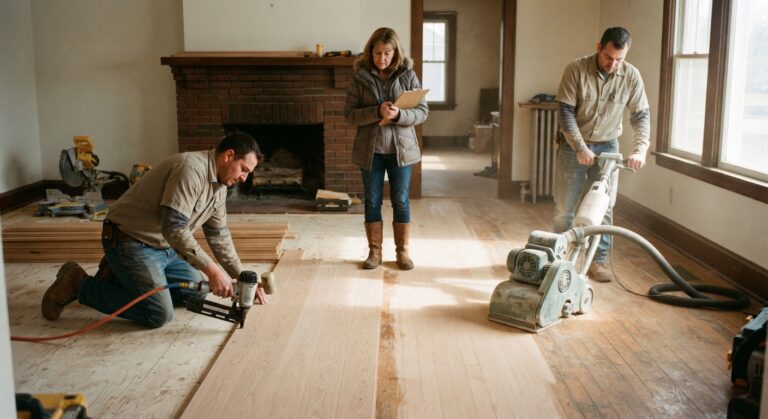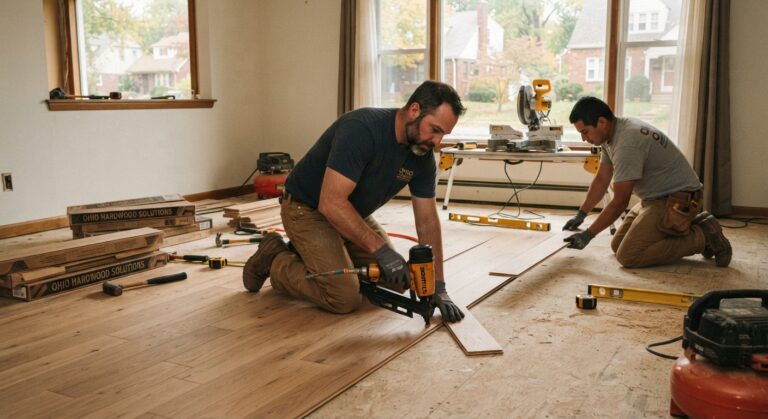

Yes, acclimating hardwood flooring before installation in Northeast Ohio is essential. Ohio’s wide seasonal humidity range can cause hardwood to expand, gap, or cup if boards are installed before they adjust to the home’s equilibrium moisture content. TH Custom Hardwood schedules material delivery 3 to 5 days before installation on every project to ensure proper acclimation for Cleveland, Akron, Canton, and Columbus homes.
What Is Hardwood Floor Acclimation and Why Does It Matter?
Acclimation is the process of allowing hardwood flooring to reach the same moisture content as the installation environment before the boards are fastened to the subfloor. Wood is hygroscopic, meaning it absorbs and releases moisture from the surrounding air continuously. When wood absorbs moisture it swells. When it loses moisture it shrinks.
If hardwood boards are installed before they acclimate, they will adjust to the home’s humidity after installation. Boards that were too dry when installed will expand and buckle. Boards that were too wet will shrink and leave visible gaps between planks. In Northeast Ohio, where indoor relative humidity varies from below 30 percent in winter to above 60 percent in summer without humidity control, this movement can be dramatic.
Proper acclimation aligns the board’s moisture content with the home’s expected equilibrium so seasonal movement is predictable and within the design tolerances built into the installation.
Northeast Ohio’s Climate Makes Acclimation Non-Negotiable
Many flooring markets in the southern United States have relatively stable year-round humidity. Northeast Ohio does not. A typical Northeast Ohio home’s indoor relative humidity fluctuates between 25 and 65 percent across the calendar year without active humidity control. This 40-point swing is among the most challenging conditions for hardwood flooring in North America.
Boards delivered from a manufacturer or warehouse in a temperature-controlled environment at 45 to 50 percent relative humidity may arrive in a Northeast Ohio home in January when indoor humidity is 28 percent. Without acclimation, those boards will lose moisture rapidly after installation and gap. The same boards delivered in August into a humid, unconditioned space will swell if installed without acclimation.
TH Custom Hardwood schedules all material deliveries to allow adequate acclimation time before the installation crew arrives. Contact TH Custom Hardwood to discuss project scheduling and acclimation planning for your home.
How Long Does Hardwood Flooring Need to Acclimate in Ohio?
The standard acclimation period for solid hardwood in Northeast Ohio is 3 to 5 days. Engineered hardwood typically acclimate in 24 to 72 hours depending on the product specification and current humidity differential. Some manufacturers specify longer acclimation periods for their products, and TH Custom Hardwood follows those specifications.
Acclimation time is affected by the gap between the board’s current moisture content and the home’s equilibrium moisture content, the width and thickness of the boards, and whether the boards are stored loosely or tightly stacked. Wider, thicker boards take longer to acclimate because moisture must travel further to reach equilibrium.
During acclimation, the home’s HVAC system must be running normally at the humidity level the home will maintain after installation. It is counterproductive to acclimate boards in a construction-humidity environment and then install them in a climate-controlled home; the boards will move after installation just as they would have without acclimation.
How to Properly Acclimate Hardwood Flooring in a Northeast Ohio Home
Proper acclimation starts with the boxes or bundles of flooring being delivered to the installation room. The boards should be stored in the room where they will be installed, not in a garage, basement, or outdoor area. The HVAC must be operating and the home must be at its normal occupied temperature and humidity.
Boards in closed boxes acclimate slowly because air circulation is limited. Many manufacturers recommend opening the boxes and cross-stacking the boards with spacers between layers to maximize air exposure. TH Custom Hardwood follows product-specific acclimation procedures for each installation.
A digital hygrometer is used to measure relative humidity in the installation area throughout the acclimation period. A moisture meter is used to check the moisture content of both the boards and the subfloor. Installation proceeds only when readings are within acceptable tolerances.
The Role of the Subfloor in Acclimation
Acclimation is not just about the boards. The subfloor must also be within the acceptable moisture range for the species being installed. A wet subfloor will transfer moisture to the new hardwood even if the boards have properly acclimated to the air in the room.
In Northeast Ohio, concrete subfloors can retain significant moisture from the building envelope or from groundwater. A calcium chloride test or Relative Humidity (RH) probe test is the industry standard for measuring concrete slab moisture. TH Custom Hardwood performs subfloor moisture testing on every installation project before the first board goes down.
Wood subfloors should be at or below 12 percent moisture content, and within 4 percentage points of the hardwood boards being installed. Subfloors above these thresholds require correction before installation, either through increased ventilation, vapor barrier application, or in severe cases, addressing the underlying moisture source.
What Happens If Hardwood Is Installed Without Acclimation?
Installing hardwood without adequate acclimation is one of the most common causes of flooring failures. Boards installed too wet will shrink as they dry to the home’s equilibrium moisture content, leaving visible gaps between planks, especially at the joints. These gaps are most noticeable during the dry winter months in Northeast Ohio.
Boards installed too dry will absorb moisture and expand. Expansion with no place to go results in boards pushing against each other until they buckle or cup upward. In severe cases, boards can lift off the subfloor or crack the tongue-and-groove joint. Cupping, where the edges of a board rise higher than the center, can also occur if moisture enters from below while the top surface dries.
These failures are typically not covered under flooring manufacturer warranties because installation without proper acclimation is considered installer error. TH Custom Hardwood’s acclimation protocol is designed to prevent these outcomes on every project.
FAQs: Hardwood Floor Acclimation in Northeast Ohio
Does engineered hardwood need to acclimate before installation in Ohio?
Yes, though typically for a shorter period than solid hardwood. Most engineered hardwood products require 24 to 72 hours of acclimation in the installation environment. Some manufacturers specify longer periods. TH Custom Hardwood follows the product manufacturer’s acclimation requirements for every installation.
Can I speed up the acclimation process in Northeast Ohio?
You can open the boxes and cross-stack boards with spacers to improve air circulation, which modestly speeds acclimation. Running the HVAC at the home’s normal operational settings rather than an extreme humidity corrects the environment faster. But acclimation cannot be rushed significantly without risking post-installation movement. The right approach is to plan for the required time.
What indoor humidity should my Ohio home be at during hardwood acclimation?
The home should be at the humidity level it will maintain after installation. The industry-standard range for hardwood flooring environments is 30 to 50 percent relative humidity. For Northeast Ohio, a target of 35 to 50 percent year-round is achievable with a whole-home humidifier and dehumidifier combination.
What moisture content should hardwood boards reach before installation?
For most domestic hardwood species installed in Northeast Ohio, a moisture content of 6 to 9 percent is typical for above-grade residential environments. The key measurement is the difference between the board’s moisture content and the subfloor’s moisture content, which should be within 4 percentage points for wood subfloors.
Will my floor gap in winter if I install it in summer in Northeast Ohio?
If the floor is properly acclimated to the home’s summer conditions and installed with appropriate expansion gaps, seasonal gaps in winter are within normal tolerances for solid hardwood. Hairline gaps of a credit card width are normal. Wider gaps indicate insufficient acclimation, incorrect expansion gap sizing, or inadequate humidity control. TH Custom Hardwood installs appropriate expansion gaps at every wall and transition.
Does TH Custom Hardwood handle acclimation as part of the installation process?
Yes. TH Custom Hardwood schedules material delivery in advance of the installation date to allow proper acclimation time. The installation crew measures moisture content of both the boards and the subfloor before beginning work. Acclimation and subfloor moisture testing are standard parts of every TH Custom Hardwood installation project.
Why Species Selection Matters for Northeast Ohio Homes
Wood species vary significantly in hardness, grain pattern, color range, and dimensional stability. In Northeast Ohio, where seasonal humidity swings between dry winters and humid summers, a species that moves excessively will gap in winter and cup in summer. A species that is too soft for the household’s foot traffic will show wear within a few years.
Species selection also affects the visual character of the home. A fine, consistent grain like hard maple reads differently than the dramatic figure of hickory. The right species for a farmhouse aesthetic differs from the right species for a mid-century modern renovation. TH Custom Hardwood brings samples to the in-home estimate so homeowners can evaluate species in their own lighting.
White Oak: The Top Choice for Northeast Ohio
White oak has become the dominant hardwood flooring species in the Northeast Ohio market, and for good reason. Its Janka hardness of 1360 makes it highly dent-resistant. Its closed grain structure resists moisture absorption better than red oak, reducing seasonal movement. Its warm, neutral tone with subtle ray fleck takes stain beautifully in everything from natural whitewash to deep espresso.
White oak is available in flat-sawn, quarter-sawn, and rift-sawn cuts. Quarter-sawn and rift-sawn white oak are more dimensionally stable than flat-sawn boards and display the ray fleck pattern prominently. These cuts cost more but are especially well-suited to wide-plank installations in Northeast Ohio homes where climate stability is a priority.
White oak also performs well in both solid and engineered formats, giving Northeast Ohio homeowners flexibility to use it above grade on wood subfloors or below grade on concrete. TH Custom Hardwood carries white oak in multiple widths and stain options.
Red Oak: Northeast Ohio’s Classic
Red oak has been the most popular hardwood flooring species in the United States for decades, and many existing Northeast Ohio homes have red oak floors that are candidates for refinishing. Red oak has a Janka hardness of 1290, an open grain with a pronounced ray pattern, and a warm pinkish undertone that deepens with age.
Red oak is slightly less stable than white oak in humid climates because its more porous grain absorbs and releases moisture faster. In Northeast Ohio homes with consistent indoor humidity control, red oak performs well for generations. Its wide availability and lower cost compared to white oak make it a practical choice for large projects.
If your existing floors are red oak and in refinishable condition, TH Custom Hardwood’s refinishing service can restore them to like-new condition at a fraction of replacement cost. Many homeowners also add new red oak to match existing floors when extending hardwood into a previously carpeted room.
Hard Maple: Best for High-Traffic Areas
Hard maple has a Janka hardness of 1450, making it harder than both oak species. Its fine, consistent grain and light, creamy color with minimal figure suit contemporary and transitional interiors. Hard maple is the standard flooring species for basketball courts, bowling alleys, and commercial kitchens because of its exceptional durability.
In Northeast Ohio residential homes, hard maple is popular in kitchens, mudrooms, and open floor plans that see heavy daily foot traffic. Its consistent appearance photographs well in real estate listings and suits minimalist design trends. Hard maple can be challenging to stain evenly due to its dense grain, and is most attractive in natural or lightly stained finishes.
Hard maple is moderately stable in Northeast Ohio’s climate. Its higher density compared to oak means it is less porous and less prone to rapid moisture absorption. TH Custom Hardwood can evaluate whether maple is the right choice for your specific installation environment.
Hickory: Maximum Hardness and Character
Hickory is the hardest of the common domestic hardwood flooring species, with a Janka hardness of 1820. Its dramatic grain variation, with alternating light and dark streaks within a single board, gives it a distinctive rustic or transitional character that works well in farmhouse, lodge, and eclectic-style Northeast Ohio homes.
Hickory’s higher density also makes it among the most dimensionally stable domestic species, moving less per unit of humidity change than oak. This makes it a practical choice for Northeast Ohio’s climate in addition to its visual appeal. Hickory is available in solid and engineered formats.
The visual variation in hickory means no two floors look alike. Homeowners who want a uniform, consistent appearance may find hickory too busy. Those who embrace its character find it one of the most striking hardwood flooring choices available. TH Custom Hardwood can bring hickory samples to your in-home consultation to assess the look in your space.
Walnut: Premium Aesthetics for Northeast Ohio Homes
American black walnut has a Janka hardness of 1010, making it softer than oak. Its rich, dark chocolate tones and fine grain make it one of the most visually striking domestic species. Walnut suits traditional, transitional, and contemporary interiors where a warm, dark palette is desired without stain.
Because walnut is softer, it is better suited to homes with lower foot traffic or homeowners who accept that some character marks will appear over time. Wide-plank engineered walnut over a multi-ply core is a popular choice that delivers the aesthetic of solid walnut with better climate stability than solid boards.
Walnut is a premium species with a higher material cost than oak or maple. For Northeast Ohio homeowners who want walnut aesthetics at a lower price point, dark-stained white oak is a common alternative.
FAQs: Best Wood Species for Hardwood Floors in Northeast Ohio
Does engineered hardwood need to acclimate before installation in Ohio?
Yes, though typically for a shorter period than solid hardwood. Most engineered hardwood products require 24 to 72 hours of acclimation in the installation environment. Some manufacturers specify longer periods. TH Custom Hardwood follows the product manufacturer’s acclimation requirements for every installation.
Can I speed up the acclimation process in Northeast Ohio?
You can open the boxes and cross-stack boards with spacers to improve air circulation, which modestly speeds acclimation. Running the HVAC at the home’s normal operational settings rather than an extreme humidity corrects the environment faster. But acclimation cannot be rushed significantly without risking post-installation movement. The right approach is to plan for the required time.
What indoor humidity should my Ohio home be at during hardwood acclimation?
The home should be at the humidity level it will maintain after installation. The industry-standard range for hardwood flooring environments is 30 to 50 percent relative humidity. For Northeast Ohio, a target of 35 to 50 percent year-round is achievable with a whole-home humidifier and dehumidifier combination.
What moisture content should hardwood boards reach before installation?
For most domestic hardwood species installed in Northeast Ohio, a moisture content of 6 to 9 percent is typical for above-grade residential environments. The key measurement is the difference between the board’s moisture content and the subfloor’s moisture content, which should be within 4 percentage points for wood subfloors.
Will my floor gap in winter if I install it in summer in Northeast Ohio?
If the floor is properly acclimated to the home’s summer conditions and installed with appropriate expansion gaps, seasonal gaps in winter are within normal tolerances for solid hardwood. Hairline gaps of a credit card width are normal. Wider gaps indicate insufficient acclimation, incorrect expansion gap sizing, or inadequate humidity control. TH Custom Hardwood installs appropriate expansion gaps at every wall and transition.
Does TH Custom Hardwood handle acclimation as part of the installation process?
Yes. TH Custom Hardwood schedules material delivery in advance of the installation date to allow proper acclimation time. The installation crew measures moisture content of both the boards and the subfloor before beginning work. Acclimation and subfloor moisture testing are standard parts of every TH Custom Hardwood installation project.